

On this page
Red light therapy went from clinic curiosity to the thing your group chat argues about in roughly eighteen months. Search interest more than doubled through 2024. Somewhere in that spike, the honest science got buried under panels that promise to fix everything short of your credit score.
This is the guide we wanted when we started building the hardware: what red light actually does, what the studies actually found, what it will not do, and how to use red light therapy at home without getting sold a floodlight you do not need. We make panels, so we have skin in this. Which is exactly why this guide spends as much time on what red light will not do, and who should skip it, as on what it will. Read on and decide for yourself.
Like this guide? We send more like it.
Research-backed light therapy explainers, straight to your inbox. No hype, no miracle claims.
Unsubscribe anytime. We never share your email.
The basics
What Is Red Light Therapy?
Red light therapy is the use of specific wavelengths of red and near-infrared light, usually somewhere between 600 and 1000 nanometers, delivered to your skin and the tissue under it. No heat to speak of. No UV. The light is absorbed by structures inside your cells, and the cells appear to respond by making energy and repairing themselves a little more efficiently.
You will see it under other names, and they all point at the same thing:
- Photobiomodulation (PBM), the term researchers settled on.
- Low-level laser therapy (LLLT), the older clinical name from when lasers did the work.
- Cold laser, near-infrared therapy, LED light therapy, depending on who is talking.
In plain English: it is targeted light your cells can use, not a tanning bed and not a heat lamp. That distinction matters, because the fastest way to spot someone who has not read the research is to hear them compare red light to either one.

The receipt
Cleveland Clinic describes red light therapy as low levels of red and near-infrared light that influence cells "without burning or damaging skin," working through the mitochondria, and calls it safe with no known side effects. It also calls the field promising and still emerging. We are going to be that honest the whole way down.
The mechanism
How Does Red Light Therapy Work?
Nearly every cell in your body runs on mitochondria, the small structures that turn oxygen and nutrients into ATP, the fuel your cells spend on everything. The leading explanation for red light goes like this:
- Red and near-infrared light is absorbed by an enzyme in the mitochondria called cytochrome c oxidase, the last stop in your cells' energy assembly line. It is the main light-catching molecule at these wavelengths.
- Under stress and age, a molecule called nitric oxide can gum up that enzyme and slow energy production. The light appears to knock that nitric oxide loose.
- With the enzyme working freely again, the cell makes more ATP, releases signaling nitric oxide that widens local blood vessels, and throws off a brief, controlled burst of reactive oxygen species that switch on the cell's own repair programs.
That last step is why one twenty-minute session can have effects that last hours. The cell gets a nudge and keeps working after you walk away.

Now the honest part, because you are smart enough to want it. This cascade is the best-supported theory, and each piece has evidence behind it. It is not fully nailed down at the molecular level. One 2020 review flatly notes that no reliable in-cell demonstration of the light-on-enzyme effect has been published yet. So when we say "researchers believe," we mean it literally. Anyone selling you settled science here is doing marketing, not biology.
The receipt
The mechanism work traces to Hamblin's reviews (2016, PMC5215795; 2018, PMC5844808), building on Karu's decades of mitochondrial research.
Red vs. near-infrared
Red Light Therapy Wavelengths: Red vs. Near-Infrared
Wavelength, measured in nanometers, decides two things: what the light does and how deep it reaches.
- Red, roughly 630 to 660nm. Visible. Absorbed mostly at the surface. This is the band that dominates the skin and collagen research.
- Deep red, around 660nm. Still visible, slightly deeper, a strong match for that cytochrome enzyme.
- Near-infrared, roughly 810 to 850nm. Invisible. Reaches deeper, into muscle and joint tissue. This is the band the recovery and pain studies lean on.
Researchers call the useful range, about 600 to 1100nm, the therapeutic window: light in this band passes into tissue instead of getting absorbed at the surface or blocked by water. Every wavelength worth using sits inside it.
The therapeutic window
Where useful wavelengths sit on the spectrum, and how deep each reaches.
Everything worth using sits between roughly 600 and 1100nm. TrueLight runs four bands inside it: 580 · 630 · 660 · 850nm.
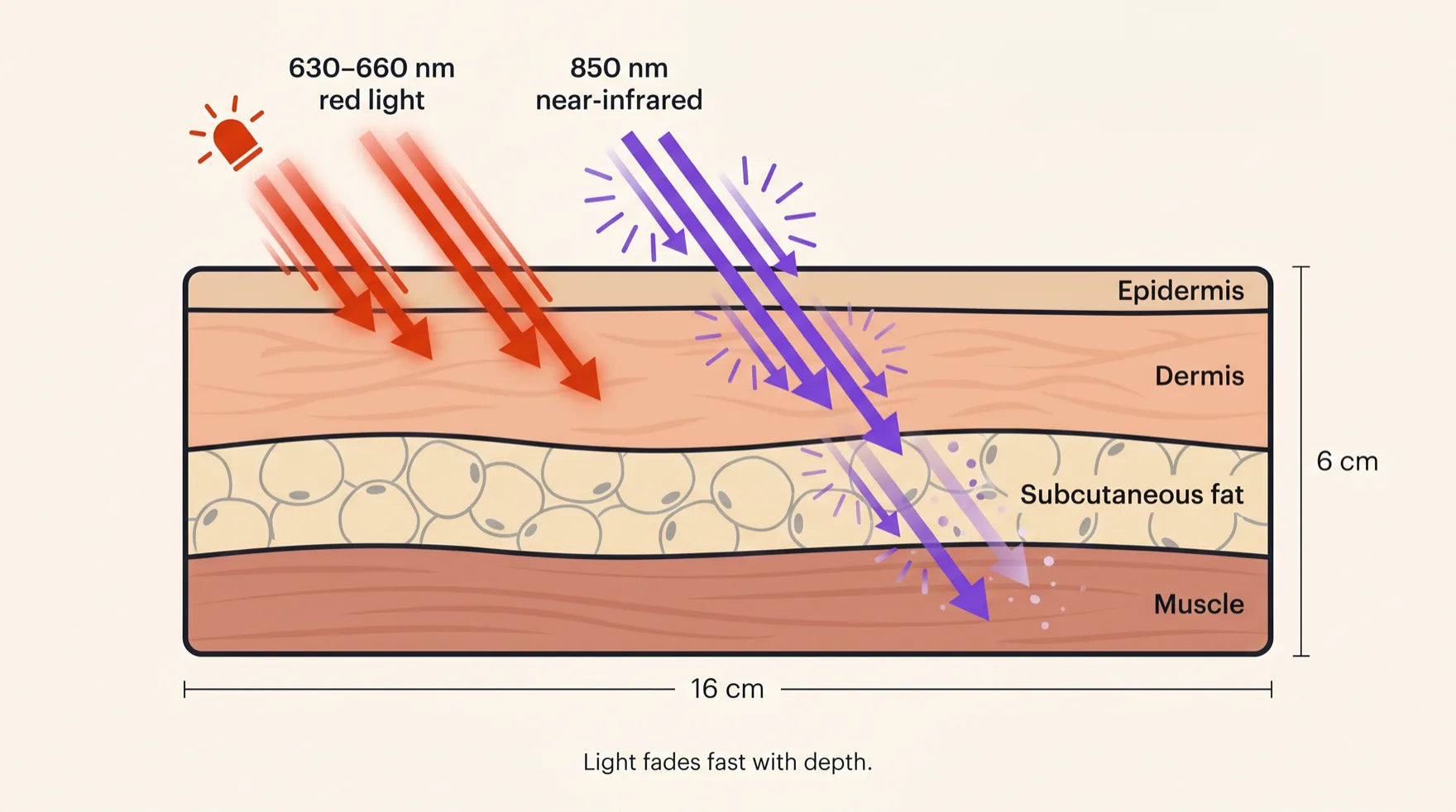
Here is where the industry earns a poke. You will see panels advertised as reaching "5 to 10 centimeters, all the way to the bone." Peer-reviewed penetration data says otherwise. Light drops off fast with depth; studies estimate that well under 2 percent of applied near-infrared reaches deep targets, and one 2024 review found over 99 percent of near-infrared light is absorbed or scattered before it even reaches the inner skull. Near-infrared does go deeper than red, meaningfully, into skin and muscle. It does not laser through you to your femur. Anyone claiming otherwise is hoping you will not check.
TrueLight panels run four wavelengths in every LED: 580nm yellow, 630nm red, 660nm deep red, and 850nm near-infrared. Most panels give you two. The point is not "more is better" for its own sake; it is that surface skin and the tissue beneath it respond to different bands, and one session covers both.
The evidence
Red Light Therapy Benefits: What the Research Actually Says
Red light therapy has been studied a lot: a 2025 umbrella review pulled together 204 randomized trials across more than 9,000 people. That is the good news. The honest news is the same review's grading: zero percent of that evidence rated "high" certainty, 17 percent moderate, 57 percent low, 26 percent very low. Translation: the direction is promising and the best use cases are real, but the field is young, the studies are small, and the dosing is all over the map. Grade the claims accordingly. We did.
How strong is the evidence, really?
GRADE certainty across 204 randomized trials (2025 umbrella review).
Promising direction, young field. We grade every claim below by how good the evidence actually is.
Here is the tiered version, strongest first.
Strong enough to lead with
Red light therapy for skin and anti-aging
Red and deep red are the most studied wavelengths in the whole field. In a 2023 controlled trial of 137 women, four weeks of red light cut wrinkle volume by roughly 30 percent. A separate controlled trial (Wunsch, 2014) measured a real increase in collagen density while the untreated group's skin got worse over the same weeks. This is the flagship use, and the receipts are the best we have.

Red light therapy for acne
A 2025 meta-analysis of randomized trials in JAMA Dermatology found home light devices meaningfully reduced acne lesions, with the strongest results from combined red-and-blue light. Worth a caveat we will not skip: red panels calm the inflammation, they are not the blue-light antibacterial half. If a red panel promises to zap acne bacteria, that is the wrong wavelength talking.
Red light therapy for wound and tissue repair
An 18-trial meta-analysis (2024) found light therapy improved wound closure and reduced pain versus standard care. Decades of healing research sit behind this one.
Red light therapy for hair growth
One of the few cosmetic uses with FDA clearance behind the category. An 11-trial meta-analysis found low-level light therapy significantly increased hair density versus sham, in both men and women. Timeline is the catch: plan on 16 weeks or more of consistent use, and know that most trials used dedicated scalp-contact caps, not a panel across the room.
Red light therapy for muscle recovery
Pooled randomized-trial data shows red and near-infrared light meaningfully reduces soreness in the days after hard training and speeds the return of your strength, while lowering creatine kinase, a blood marker of muscle damage. Light the muscles you worked, after you work them.
Real, but be precise
Red light therapy for joint pain and arthritis
A Cochrane review found low-level light therapy reduced rheumatoid arthritis pain and cut morning stiffness by nearly half an hour. Knee osteoarthritis shows meaningful relief too, best when the light is paired with the movement the joint needs anyway. Near-infrared is the band doing the deeper work here.
Red light therapy for pain and inflammation
Consistent, moderate evidence that light dials down the inflammatory signaling behind soreness and stiffness.
Promising, but early. Hedge accordingly
Red light therapy for sleep
This is the benefit our own customers report first and most vividly, and unlike screens, red and near-infrared light do not suppress melatonin, so an evening session fits a wind-down. The clinical evidence, though, is thin: the strongest positive study is small, and a pooled analysis came back null. We will tell you people love it for sleep and that the trials have not caught up. Both are true.
Red light therapy for mood, focus, and the brain
Early transcranial studies are interesting and nowhere near settled. File under "watch this space," not "buy this for depression."
Red light therapy for energy
The safest systemic framing, because it rides the one mechanism with the most support: the mitochondria making more ATP.
What we will not sell you
Because the tell of an honest guide is what it refuses to claim:
We won't sell you
- Seasonal affective disorder. In the actual SAD trials, red light is the placebo arm. Bright white light is the treatment. We are not going to sell you the sugar pill.
- Testosterone. The viral "10 to 20 percent boost" stat traces back to nothing solid. No robust human trial exists. Skip it.
- Weight loss, detox, and thyroid cures. Cleveland Clinic lists these among the claims that have run ahead of the evidence. So do we.
These statements have not been evaluated by the FDA. TrueLight is not intended to diagnose, treat, cure, or prevent any disease.
Get the red light dosing cheat sheet.
Session times, distances, and frequency by goal, on one page. Saved to your phone.
Free PDF. We'll add you to our light therapy tips list.
The dose science
Red Light Therapy Dosage: Why More Is Not Better
This is the single most misunderstood thing in red light, and it is worth getting right, because the intuitive answer, that more and stronger must be better, is wrong.
Light dose has a few parts. Irradiance (power density, in mW/cm²) is how strong the light is at your skin. Dose (in J/cm²) is irradiance times time, and it is the number studies report. Distance matters more than people think: intensity falls off roughly with the square of the distance, so doubling how far you sit quarters the light you receive.
The biphasic dose response
Benefit is a hump, not a ramp. Too little does nothing; too much reverses it.
In one landmark study, benefit peaked around 2 J/cm², while a big 50 J/cm² dose made wound healing worse.
The receipt
Huang and Hamblin documented the biphasic curve across the low-level-light literature (2009 and 2011 reviews).
So here is the practical takeaway: what moves your results is the right wavelengths, applied close to bare skin, often enough to matter. Once a panel delivers a therapeutic dose at the distance you actually use it, consistency and proximity do the rest. That is what the biphasic curve is really telling you.
Protocols
How to Use Red Light Therapy: Protocols and How Often
There is no single magic number, because the right session depends on your device, your distance, and your goal. But you do not need a spreadsheet. Start here and adjust.
The simple default (TrueLight panels)
About 20 minutes per area, positioned 3 to 6 inches from bare skin, 3 to 5 times a week. Skin loves consistency more than it loves marathon sessions. Never more than one session per area per day, and start with 10 minutes if you are new.
If you're brand new
- Duration
- 10–15 min
- Frequency
- 3×/week
- Distance
- 3–6 in
- Judge after
- 2–4 weeks
Once your body knows the drill
- Duration
- 20 min
- Frequency
- 3–5×/week, daily is fine
- Distance
- 3–6 in
- Dose
- Sensible
Golden rules
- Skin
- Bare, not clothed
- Wins from
- Consistency
- Not from
- Marathon sessions
- Per area
- 1×/day max
Tuned to the goal
Skin. Red and deep red (630 to 660nm). 10 to 15 minutes, 6 to 12 inches, most days. Give it 4 to 12 weeks. Skin is a slow win, and we would rather tell you that now than take the return later.
Pain and recovery. Lean on near-infrared (850nm) for depth. About 20 minutes on the area, a few inches away. Daily during a flare.
Whole-body wellness and sleep. Full four-wavelength exposure, about 20 minutes, 3 to 6 inches from a full-body panel. Evening works because red light does not spike your alertness the way blue does.

Bare skin beats clothing every time. Fabric scatters and blocks the light, so you are paying dose to warm your shirt.
Buying guide
How to Choose a Red Light Therapy Device (Panels and More)
The best red light therapy device is the one built around how you will actually use it: the right wavelengths, a sensible dose at close range, low EMF, and a company that stands behind it. Everything else is packaging. Here is how the main types compare.
Panels
The workhorses: most output, most flexibility. Skin one day, a sore knee the next.
Masks & wands
Fine starters, but only ever treat a small patch at a time.
Blankets & mats
Wrap you for hands-free, full-body warmth and lie-down recovery.
Beds & booths
Live in clinics and cost per visit. Great access, no ownership.
When you compare panels, look at four things
- A therapeutic dose at a usable distance. Because of the dose response, what matters is that a panel puts enough light on your skin at the distance you will actually sit. That, more than any single spec, is what determines the dose you get (see the dosage section).
- Verified wavelengths. Red and near-infrared at minimum. Bonus if the brand tells you the actual nanometers, not just "red."
- EMF and flicker. Cheap drivers buzz with both. A quiet, low-EMF panel is a design choice, not an accident.
- The clearance theater. "FDA cleared" means the FDA reviewed the device. "FDA registered" just means someone paid a listing fee, with no testing and no permission to make treatment claims. Brands blur those two on purpose. Now you will not fall for it.

TrueLight panels were built around exactly those specs: four wavelengths in every LED (580, 630, 660, 850nm), low EMF, quiet operation, and a design tuned for close-range use, so a normal 6-to-8-inch session lands right in the therapeutic range. Engineered around the dose science, under Dave Asprey.
Safety
Is Red Light Therapy Safe? Side Effects and Contraindications
Used as directed, red light therapy has a strong safety record. Unlike UV, red and near-infrared light are non-ionizing: at appropriate doses they do not tan, burn, or damage DNA. Most people feel nothing but a little warmth and, on the honesty ledger, some people feel nothing at all. We would rather you know that before you buy than after.
Play it safe
- Start short (about 10 minutes) and build up.
- Do not stare into the LEDs. Close your eyes, and use eye protection for face and neck sessions. The light will not damage your eyes the way UV does, but it is bright and can strain them.
- Keep bare skin at the recommended distance.
Check with a doctor first if you
- Are pregnant or breastfeeding (precautionary).
- Take photosensitizing medication (isotretinoin, some antibiotics, St. John's Wort, and others).
- Are in cancer treatment or have a suspicious lesion. Do not treat directly over an active cancer site without guidance.
- Have a thyroid condition and are considering neck sessions.
- Have a seizure disorder triggered by flashing light (relevant to pulsing modes).
The honest side-effect list is short: occasional eye strain, rare mild skin irritation, headaches from overdoing it, and sleep disruption if you run an energizing session too late. Almost all of it resolves by dialing the dose or the timing back.
Myth-busting
Red Light Therapy Myths and Misconceptions
FAQ
Red Light Therapy FAQ
Does red light therapy really work?
For some things, yes, with real evidence: skin (a 137-woman trial cut wrinkle volume by roughly 30 percent), wound healing, pattern hair loss, muscle recovery, and certain joint pain. For others, like weight loss, testosterone, and seasonal depression, the evidence is weak or absent. Grade the claim by the use case, not the marketing.
How often should you do red light therapy?
Three to five sessions a week is a solid target for most goals. Consistency beats any single long session. Once you know how your body responds, a short daily session is fine.
How long should a session be?
Usually 10 to 20 minutes per area. On a TrueLight panel, about 20 minutes at 3 to 6 inches is the simple, effective default.
Can you do it every day?
Yes, at sensible doses. Start shorter and build up.
How long until I see results?
Depends on the goal. Recovery and sleep, days to a couple of weeks. Skin, weeks to a few months. Hair, 16 weeks or more.
Is red light therapy bad for your eyes?
It does not damage the eyes the way UV does, but it is bright and can cause temporary strain. Do not stare into the LEDs; wear eye protection for face and neck sessions.
Can you use it while pregnant?
It is considered low-risk, but as a precaution, check with your provider first, especially for sessions over the abdomen.
Does it work through clothes?
Not well. Fabric blocks and scatters the light. Expose bare skin for the real dose.
Does red light therapy cause cancer?
No. The wavelengths are non-ionizing and do not damage DNA the way UV does. Do not treat directly over an active cancer site without medical guidance.
Does it help with hair growth?
Yes, for pattern hair loss, red around 650 to 660nm plus near-infrared has FDA-cleared applications for stimulating follicles. Plan on 16 to 26 weeks of consistent use.
Is it good for acne, rosacea, and redness?
Red and deep red are widely used to calm redness and inflammation and support clearer skin. Results build over several weeks. For acne specifically, red is the anti-inflammatory half; the strongest studies pair it with blue.
Can red light therapy help with weight loss?
Not meaningfully. A few studies show modest, temporary reductions in waist or hip circumference from a specific in-clinic laser protocol, but that is contouring, not fat loss, and it is not what an at-home panel is built for. Anyone selling red light as a weight-loss device is running ahead of the evidence.
Does a more powerful panel work better?
Not necessarily. Because of the biphasic dose response, what matters is getting a therapeutic dose at the distance you actually use, which a well-designed panel does at close range. Beyond that, consistency and the right wavelengths do more for your results than a higher output number.
Getting started
How to Get Started With Red Light Therapy at Home
You do not need a complicated setup. Match the device to the goal, start conservative, and stay consistent.
Pick the panel that fits how you'll use it
Face and spots, full-body, or lie-down recovery, there's a device shaped for each. See the three below.
Start conservative
About 20 minutes at 3 to 6 inches, 3 to 5 times a week. Start with 10 minutes the first week, then watch how you respond and adjust.
Track it
Keep a simple log of sessions and what you notice. Most benefits show up within 2 to 8 weeks of consistent use.

Energy Square 2.4
Face, neck, and targeted spots like a shoulder or knee. Thin, one-handed, travels.
Shop the Square
Energy Trism
Full-body sessions and larger areas. Three 12-inch panels, folds flat. Add the Trism Stand for hands-free standing use.
Shop the Trism
Luna Red Blanket
Wrap-around, lie-down recovery without standing in front of a panel.
Shop the BlanketNot sure? Compare all three, or browse the shop.
Get $25 off your first panel.
Join the list for your welcome code, plus practical protocols and new releases.
New subscribers only. Code WELCOME25, applied to panels.
Every TrueLight device runs the same four therapeutic wavelengths, was engineered under Dave Asprey, and ships with low EMF, a built-in timer, a 1-year warranty, and a 60-day money-back guarantee. Use it for 60 days. If it is not part of your routine, send it back, opened and used is fine.
Everything you just read, built into the panel.
Four therapeutic wavelengths in every LED, low EMF, engineered under Dave Asprey, and backed by a 60-day money-back guarantee. Try it for 60 days.
Shop the lineup Why Dave built TrueLight